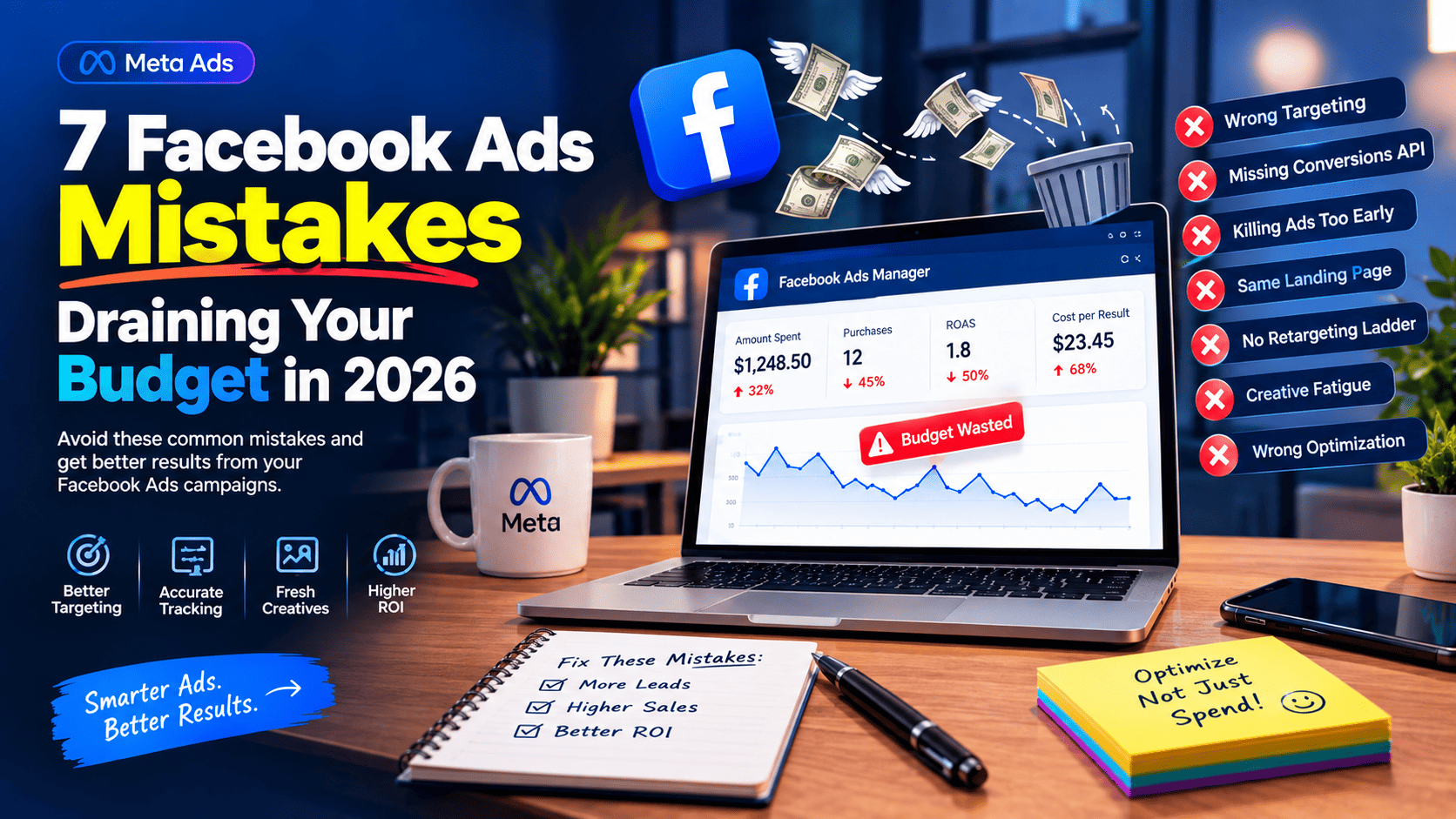
7 Facebook Ads Mistakes Draining Your Budget in 2026
Facebook and Instagram advertising can be one of the most effective ways to generate leads, sales, and brand awareness. But even a well-funded campaign can waste money when the strategy behind it is wrong.
After auditing hundreds of advertising campaigns, we repeatedly see the same problems: weak creative segmentation, incomplete tracking, premature optimization, poor landing-page alignment, and ineffective retargeting.
The good news is that most of these Facebook Ads mistakes are fixable without simply increasing your advertising budget.
Here are seven common mistakes to watch for in 2026—and what you can do instead.
1. Using Broad Targeting Without Creative Segmentation
Broad targeting can work well when your advertising system has enough data and your creative clearly communicates who the offer is for.
The problem starts when businesses combine broad targeting with a single generic advertisement.
Different customer personas have different problems, motivations, and reasons to buy. One creative rarely speaks equally well to everyone.
What to do instead
Create multiple creative angles based on your key customer segments.
For example:
- Problem-focused creative for customers actively looking for a solution
- Benefit-focused creative for users comparing options
- Social-proof creative for users who need additional trust
- Offer-focused creative for price-sensitive audiences
This allows the creative itself to provide more context while giving Meta more variations to test.
Key takeaway: Broad targeting works better when your creative strategy is specific.
2. Ignoring the Meta Conversions API
Accurate tracking is essential for effective Facebook Ads optimization.
Browser-based tracking can lose data because of privacy restrictions, browser limitations, cookie restrictions, and other technical factors. Relying only on the Meta Pixel can therefore give the platform incomplete conversion signals.
The Conversions API (CAPI) allows businesses to send relevant conversion events directly from their server or through supported integrations.
What to do instead
Where technically appropriate, use both:
- Meta Pixel
- Conversions API
- Proper event configuration
- Domain verification
- Event prioritization
- Conversion tracking
Better data can give Meta stronger signals for campaign optimization and reporting.
Key takeaway: Don't make important advertising decisions using incomplete conversion data.
3. Killing Ads Too Early
One of the most common Facebook Ads mistakes is making decisions before a campaign has collected enough meaningful data.
An ad that performs poorly during its first day or two isn't necessarily a bad ad. Similarly, an ad that gets early clicks may not ultimately produce profitable conversions.
Campaign performance needs to be evaluated based on the conversion event that actually matters to your business.
What to do instead
Give campaigns enough time and data to produce meaningful insights before making major changes.
Monitor metrics such as:
- Cost per result
- Conversion rate
- CTR
- CPM
- CPC
- Frequency
- ROAS
- Lead quality
Avoid making significant changes every few hours simply because performance fluctuates.
Key takeaway: Optimize based on meaningful conversion data—not short-term noise.
4. Sending Every Campaign to the Same Landing Page
Your advertisement makes a specific promise. Your landing page needs to continue that conversation.
Sending every Facebook Ads campaign to the same generic homepage can create a disconnect between the ad and the user's expectations.
For example, a first-time visitor may need education and trust-building, while someone who has already visited your website may need a stronger offer or a direct path to purchase.
What to do instead
Create landing pages that match the campaign's:
- Audience
- Ad message
- Offer
- Customer intent
- Conversion goal
This concept is known as message match.
The closer the relationship between your ad and landing page, the easier it is for users to understand what you're offering.
Key takeaway: Don't make users search for the promise you made in your advertisement.
5. Not Building a Retargeting Ladder
Not every website visitor is ready to buy immediately.
Someone who watched 75% of your video is different from someone who added a product to their cart. Treating both users exactly the same can make your retargeting strategy less effective.
A structured retargeting funnel can help you deliver increasingly relevant messages based on user behavior.
A simple retargeting ladder
Stage 1 — Engaged Viewers
Show educational content, benefits, or social proof.
Stage 2 — Website Visitors
Introduce stronger reasons to choose your product or service.
Stage 3 — Product or Service Viewers
Address objections and reinforce value.
Stage 4 — Add-to-Cart Users
Present stronger purchase incentives, reviews, or reminders.
Stage 5 — Existing Customers
Promote complementary products, upgrades, or repeat purchases.
Key takeaway: Retarget people based on what they did—not simply the fact that they visited your website.
6. Forgetting About Creative Fatigue
Even a high-performing advertisement can eventually lose effectiveness.
When the same audience repeatedly sees the same creative, engagement can decline and advertising costs may increase.
This is known as creative fatigue.
Common warning signs include:
- Rising frequency
- Declining CTR
- Increasing CPC
- Falling conversion rates
- Increasing cost per lead
- Lower engagement
What to do instead
Don't immediately rebuild your entire campaign when performance declines.
First, test new creative variations:
- New hooks
- Different headlines
- New visuals
- Short-form videos
- Customer testimonials
- UGC-style content
- Different offers
- Alternative calls to action
If the audience is still relevant, refreshing the creative may be more useful than constantly changing the targeting.
Key takeaway: When creative performance declines, test new creative before assuming the audience is the problem.
7. Optimizing for the Wrong Conversion Event
Clicks are easy to measure—but clicks don't necessarily generate revenue.
If your actual business objective is sales, optimizing your campaign primarily around cheap traffic can produce visitors who have little intention of buying.
For an eCommerce business, for example, a purchase is generally more valuable than a simple link click.
For a lead-generation business, a qualified lead may be more meaningful than a landing-page visit.
What to do instead
Choose a conversion event that is closely connected to your actual business objective.
Depending on your business, that could include:
- Purchase
- Qualified Lead
- Registration
- Booking
- Application
- Subscription
Then make sure your tracking setup is correctly measuring that event.
Key takeaway: Optimize for the action that creates business value—not simply the metric that looks cheapest.
How to Stop Wasting Your Facebook Ads Budget
Before increasing your advertising budget, review your existing campaigns.
Ask yourself:
Targeting
Are your audiences aligned with your customer segments?
Creative
Does each ad communicate a clear problem, benefit, or offer?
Tracking
Are you accurately measuring the conversions that matter?
Landing Page
Does the landing page match the promise made in the ad?
Retargeting
Are different levels of intent receiving different messages?
Performance
Are you giving campaigns enough meaningful data before making decisions?
Conversion
Are you optimizing toward revenue-generating actions?
Fixing these fundamentals can often create more meaningful improvements than simply increasing ad spend.
Final Thoughts
Facebook Ads can deliver impressive results, but successful advertising requires more than launching a campaign and waiting for conversions.
The biggest opportunities often come from fixing the fundamentals:
Better creative → Better tracking → Better landing pages → Better retargeting → Better optimization
If your Facebook or Instagram campaigns are generating clicks but not enough qualified leads or sales, review these seven areas before increasing your budget.
A better strategy can help you get more value from the budget you're already spending.
Need Help Optimizing Your Facebook Ads?
Capstech IT helps businesses create, manage, and optimize Facebook and Instagram advertising campaigns focused on measurable business results.
From audience research and creative strategy to campaign optimization, conversion tracking, and retargeting, our team can help you build a more effective paid advertising strategy.
Get a Free Consultation →
Could you do a follow-up on Advantage+ shopping campaigns? Curious how they fit into this framework.