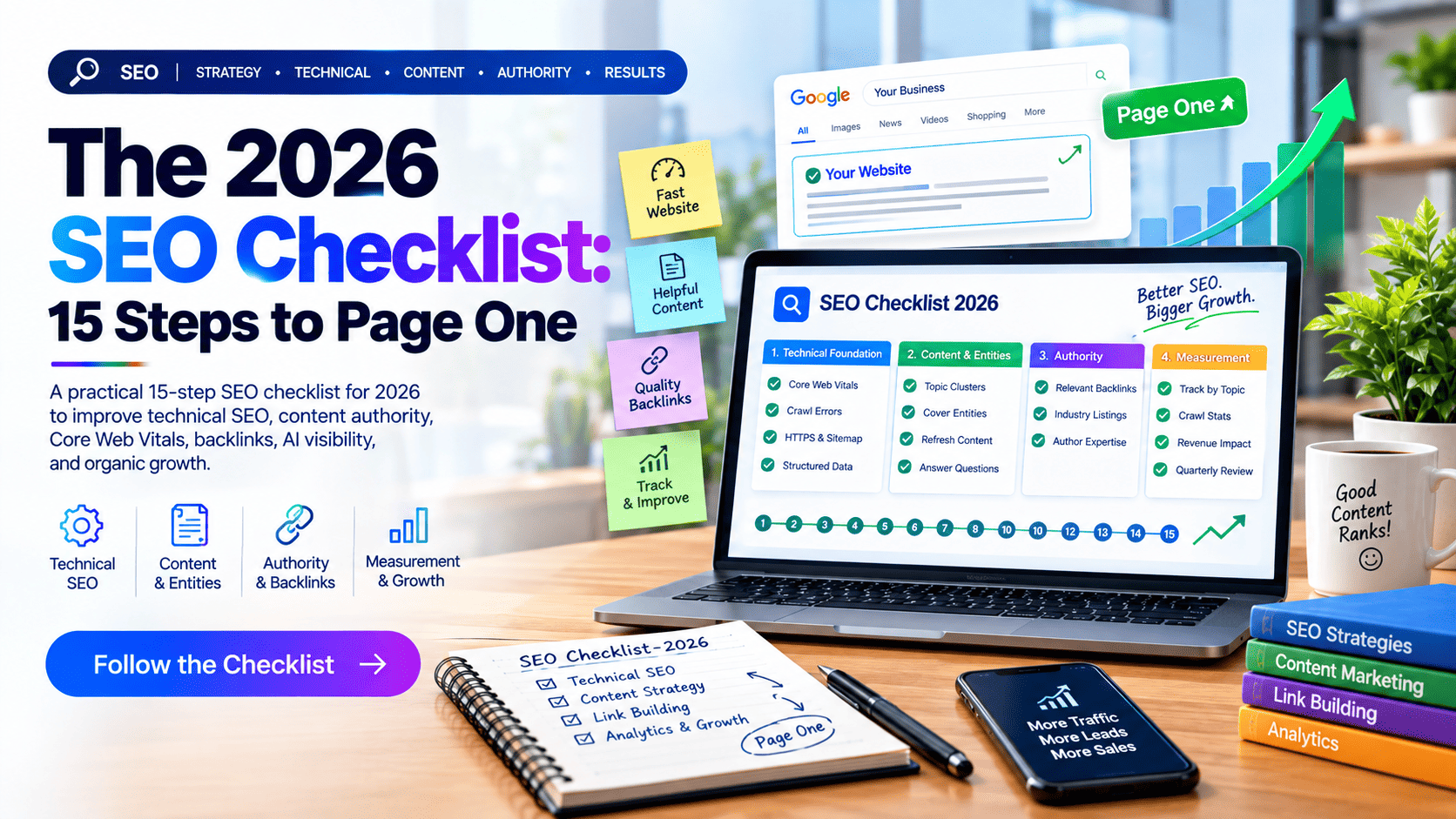
The 2026 SEO Checklist: 15 Steps to Page One
SEO continues to evolve, but the fundamentals remain clear: websites need to be technically accessible, useful to users, authoritative within their topics, and easy for search engines to understand.
In 2026, successful SEO isn't simply about adding keywords to pages. A strong SEO strategy combines technical performance, topical authority, helpful content, structured information, relevant authority signals, and meaningful measurement.
Use this 15-step SEO checklist to review your website from top to bottom.
Technical SEO Foundation
Before investing heavily in content or link building, make sure search engines can efficiently crawl, understand, and index your website.
1. Optimize Core Web Vitals
Website performance directly affects user experience, particularly on mobile devices.
Review your site's Core Web Vitals and focus on:
- Loading performance
- Interaction responsiveness
- Visual stability
- Mobile usability
- Page speed
- Image optimization
- JavaScript performance
A fast website provides a better experience for visitors and creates a stronger technical foundation for SEO.
Action: Regularly test important pages and prioritize issues affecting real users.
2. Fix Crawl Errors and Orphan Pages
Search engines need to discover your important pages through a logical internal linking structure.
Common technical problems include:
- Broken links
- 404 errors
- Redirect chains
- Incorrect canonical tags
- Orphan pages
- Blocked resources
- Incorrect indexing directives
An orphan page is a page that has no meaningful internal links pointing to it, making it harder for search engines and users to discover.
Action: Review your crawl data regularly and ensure every important page has a clear place within your site's architecture.
3. Use HTTPS and Maintain a Clean XML Sitemap
Security and crawlability are fundamental parts of a technically healthy website.
Make sure:
- Your entire website uses HTTPS
- HTTP pages redirect correctly
- Your XML sitemap contains important indexable URLs
- Deleted URLs are removed from the sitemap
- Canonical URLs are consistent
- Your robots.txt file is correctly configured
Your sitemap should help search engines understand which URLs you consider important.
Action: Keep your sitemap clean, updated, and free from unnecessary URLs.
4. Implement Structured Data
Structured data helps search engines better understand the meaning and context of your content.
Depending on your website, relevant structured data may include:
- Organization
- Article
- Breadcrumb
- Product
- Local Business
- FAQ
- Service
Use structured data only where it accurately represents the content visible on the page.
Action: Validate your structured data and keep it aligned with Google's current documentation and eligibility requirements.
Content & Topical Authority
Technical SEO gets search engines to your content. Strong content helps demonstrate that your website deserves visibility for relevant searches.
5. Build Topic Clusters Around Important Keywords
Instead of creating isolated articles around individual keywords, build comprehensive topic clusters.
For example, a digital marketing website might create a central topic around Facebook Ads, supported by articles such as:
- Facebook Ads for Beginners
- Facebook Ads Mistakes
- Facebook Ads Retargeting
- Facebook Ads Creative Strategy
- Facebook Ads Optimization
- Facebook Ads Conversion Tracking
Connect related pages through strategic internal links.
This creates a clearer topical structure for both users and search engines.
Action: Identify your most valuable topics and build supporting content around them.
6. Cover Relevant Entities and Concepts
Modern search systems increasingly rely on understanding relationships between concepts, entities, topics, and user intent.
Instead of repeatedly using the same keyword, create content that comprehensively covers the subject.
For example, an article about SEO may naturally discuss:
- Search intent
- Crawling
- Indexing
- Keywords
- Internal linking
- Structured data
- Core Web Vitals
- Backlinks
- Content quality
- Search Console
The goal isn't to insert every related term artificially. The goal is to provide a complete and useful explanation.
Action: Ask whether your content adequately covers the concepts a reader would reasonably expect from the topic.
7. Refresh Content That Is Losing Traffic
Even strong content can become outdated.
Information, statistics, products, search behavior, and industry practices change over time.
Look for pages experiencing:
- Declining organic traffic
- Falling rankings
- Outdated information
- Old screenshots
- Broken links
- Missing sections
- Outdated examples
Update the content where there is a genuine reason to do so.
Action: Review important content at least quarterly and prioritize pages showing signs of declining performance.
8. Create Content That Answers Searchers' Questions
Search behavior increasingly includes conversational and question-based queries.
Your content should answer important questions clearly and directly.
Consider including:
- FAQs
- Step-by-step explanations
- Definitions
- Comparisons
- Examples
- Expert insights
- Original research
- Practical recommendations
Search features and AI-generated search experiences may surface information from pages that clearly answer specific questions.
Action: Identify the questions your target audience asks and provide concise, useful answers backed by trustworthy information.
Build Website Authority
Great content needs credibility. Build authority through relevant relationships, expertise, and trustworthy signals.
9. Earn Relevant Backlinks
Backlinks can still contribute to a website's authority, particularly when they come from relevant and reputable websites.
Focus on earning links through:
- Original research
- Useful resources
- Industry studies
- Digital PR
- Expert contributions
- Data-driven content
- High-quality guides
Avoid focusing solely on the number of backlinks.
A smaller number of genuinely relevant links can be more meaningful than a large collection of low-quality links.
Action: Create content that other websites have a legitimate reason to reference.
10. Build Relevant Industry Citations and Listings
Depending on your industry, relevant directories, professional associations, business listings, and industry databases can help establish your business presence.
For local businesses, make sure your important business information is consistent across relevant platforms.
Check:
- Business name
- Address
- Phone number
- Website
- Business category
- Service information
Action: Prioritize reputable and relevant platforms instead of submitting your business to hundreds of unrelated directories.
11. Strengthen Author and Expertise Signals
People want to know who created the information they're reading.
For expert-led content, provide useful author information such as:
- Author name
- Professional role
- Relevant experience
- Areas of expertise
- Author profile
- Professional credentials where appropriate
- Links to other relevant work
This can make your content more transparent and trustworthy.
Action: Give readers enough information to understand why the author is qualified to discuss the subject.
Measurement & SEO Performance
SEO isn't complete when a page ranks. You need to understand whether organic visibility is contributing to meaningful business outcomes.
12. Track Performance by Topic Cluster
Tracking hundreds of individual keywords can make SEO reporting unnecessarily complicated.
Instead, organize keywords and pages into meaningful topic clusters.
For example:
Topic: Facebook Ads
Track:
- Facebook Ads
- Facebook advertising
- Facebook Ads management
- Facebook Ads agency
- Facebook Ads optimization
Then evaluate the overall performance of the topic.
Action: Measure visibility and traffic at both the page and topic level.
13. Monitor Crawl and Indexing Data
Google Search Console provides valuable information about how Google interacts with your website.
Regularly review:
- Indexing issues
- Crawl activity
- Search performance
- Sitemap status
- Page indexing
- Search queries
- Core Web Vitals
You don't necessarily need to check everything every day.
Action: Schedule a technical SEO review at least once a month.
14. Connect Organic Traffic to Business Revenue
Traffic is useful, but traffic alone isn't the ultimate business objective.
Your analytics should help answer questions such as:
- Which organic pages generate leads?
- Which landing pages generate sales?
- Which topics attract qualified visitors?
- Which keywords contribute to conversions?
- Which content assists customer journeys?
Connect your SEO reporting with your business's conversion and revenue data wherever possible.
Action: Move beyond measuring sessions and rankings. Measure the business value generated by organic search.
15. Review Your SEO Strategy Every Quarter
Search doesn't stand still.
Your competitors publish new content. Your customers change their behavior. Search features evolve. Your own products and services change.
That's why SEO should be treated as an ongoing process rather than a one-time project.
Every quarter, review:
- Technical SEO
- Content performance
- Keyword visibility
- Topic clusters
- Backlinks
- Search Console data
- Conversion performance
- Competitor activity
- Content gaps
Then update your priorities based on what the data shows.
2026 SEO Checklist: Quick Summary
Use this quick checklist when auditing your website:
☐ Core Web Vitals reviewed
☐ Mobile experience optimized
☐ Crawl errors fixed
☐ Orphan pages identified
☐ HTTPS implemented correctly
☐ XML sitemap cleaned and updated
☐ Structured data implemented where appropriate
☐ Topic clusters created
☐ Important entities and concepts covered
☐ Declining content refreshed
☐ Relevant backlinks earned
☐ Industry listings reviewed
☐ Author expertise made clear
☐ SEO performance tracked by topic
☐ Organic traffic connected to business outcomes
Final Thoughts
SEO in 2026 is less about chasing individual ranking tricks and more about building a website that search engines can understand and users genuinely find useful.
Start with the technical foundation. Build comprehensive content around important topics. Demonstrate genuine expertise. Earn relevant authority. Then measure how organic search contributes to your business.
Work through these 15 SEO steps systematically, review your progress every quarter, and keep improving as search technology and user behavior evolve.
Need help improving your website's SEO? CapstechIT provides professional SEO, technical optimization, content marketing, and digital growth solutions designed to help businesses build stronger organic visibility.
Best SEO checklist I have seen this year — bookmarked and shared with my team.